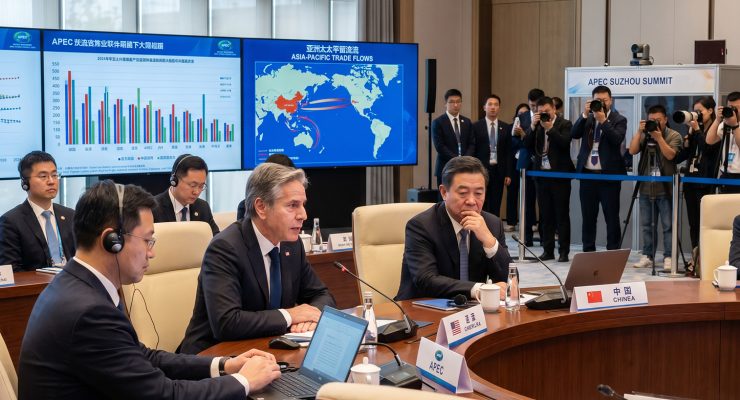
The US-China trade war has entered a phase no tariff schedule can fully capture. At the Asia-Pacific Economic Cooperation summit in Lima, Peru, three signals made plain that Washington and Beijing are no longer simply quarrelling over goods. They are competing over the architecture of Asia’s economic future, and the gap between their visions is wider than any negotiating table has managed to close.
The surface narrative at recent APEC meetings has been familiar. American and Chinese officials have met on the margins, issued careful statements about “stabilising” relations, and pledged to keep communication open. Yet the substance underneath tells a different story.
Sign One: Two Incompatible Visions of Openness
China has arrived at each APEC forum in recent years carrying a consistent message: the Asia-Pacific region should embrace open multilateralism and resist what Beijing characterises as economic “coercion.” Xi Jinping’s delegation has pushed for communique language emphasising free trade principles and opposing “unilateral measures” and “protectionism,” terms that, while technically neutral, are aimed at American tariff and export control policy.
The American delegation frames the same period in different terms. “Rebalancing,” “reciprocity,” and “fairness” are the operative concepts. They point to a different underlying theory: that the rules-based trading system was gamed for decades, and that correcting structural imbalances justifies departing from conventional multilateral norms.
These are not merely rhetorical differences. They reflect incompatible theories of how global trade should be governed. Beijing wants a system in which the United States must justify departures from openness. Washington wants a system flexible enough to account for what it calls structural distortions. Neither position has shifted in years.
Sign Two: The US-China Trade War Has Produced Two Parallel Economic Frameworks
The rivalry has accelerated the construction of two distinct regional economic architectures, and APEC has offered a concentrated view of both in operation. China’s application to join the Comprehensive and Progressive Agreement for Trans-Pacific Partnership, filed in September 2021, has advanced slowly. The eleven-member bloc has resisted taking up Beijing’s membership bid, in part because of pressure from existing members worried about market-access standards and state subsidy rules that China’s economic model would strain.
The American answer to regional integration is the Indo-Pacific Economic Framework for Prosperity, launched in May 2022. The IPEF attracted 14 members, including Japan, South Korea, and India. It contains no market access component, no reduced tariffs, no preferential terms. It is, in effect, an attempt to build supply chain resilience and set labour, environmental, and digital standards without the trade liberalisation that historically made such frameworks attractive to developing economies.
The consequence is visible across Southeast Asia. Countries in the region are managing two sets of relationships simultaneously: deepening trade ties with China, which remains the dominant trading partner for most of the bloc, while accommodating American pressure to diversify supply chains and reduce technology dependencies. Vietnam, Malaysia, and Indonesia each carry that dual burden into every APEC session.
Sign Three: The Contest Over AI and Technology Governance
The newest front is also the most consequential. The US-China trade war has evolved into a technology race, and APEC has become the venue where competing governance frameworks are tested against each other.
China has pushed consistently for an “inclusive” approach to artificial intelligence development at multilateral forums, arguing that developing nations should have full access to AI tools and infrastructure without being constrained by export controls or proprietary ecosystems. This translates, in regional forums, into support for open digital infrastructure investment and opposition to restrictions on semiconductor trade.
The American position rests on a different premise: that AI and advanced semiconductors represent national security assets, not merely commercial goods. Export controls on high-performance chips, imposed and expanded since 2022, reflect a view that military-relevant AI capabilities must not be allowed to develop in adversarial hands, regardless of the commercial cost to allied suppliers.
Neither side has persuaded the other, but the contest has practical consequences for every economy in the region. Japan and the Netherlands have joined the American export controls regime. South Korea and Taiwan are aligned with Washington on semiconductor policy while remaining deeply integrated with Chinese supply chains. For smaller economies across Southeast Asia, the technology question has become as politically fraught as the tariff question once was.
What the Distance at APEC Actually Means
Two sides that disagree on the definition of openness, build parallel economic architectures, and hold incompatible positions on technology governance are not on a path toward a comprehensive trade agreement.
The financial markets have already begun adjusting to this structural reality. Rising US Treasury yields reflect, in part, a world in which the assumptions underlying the post-war financial architecture are no longer insulated from geopolitical fracture.
This does not mean Asia will split cleanly into blocs. Most economies in the region will continue managing both relationships because they cannot afford to choose. But the signals from recent APEC summits suggest that the pressure to make harder choices is growing, not receding.
Countries that built their economic models on simultaneous access to the American market and Chinese supply chains now face a slow-moving decision that each passing summit makes harder to defer. The meetings have delivered no resolution, no roadmap, and no sign that either government is prepared to concede the terms the other insists upon. That absence, more than any statement issued, is the clearest signal of all.